Ecommerce SEO · Schema · Content · Splotch Studio
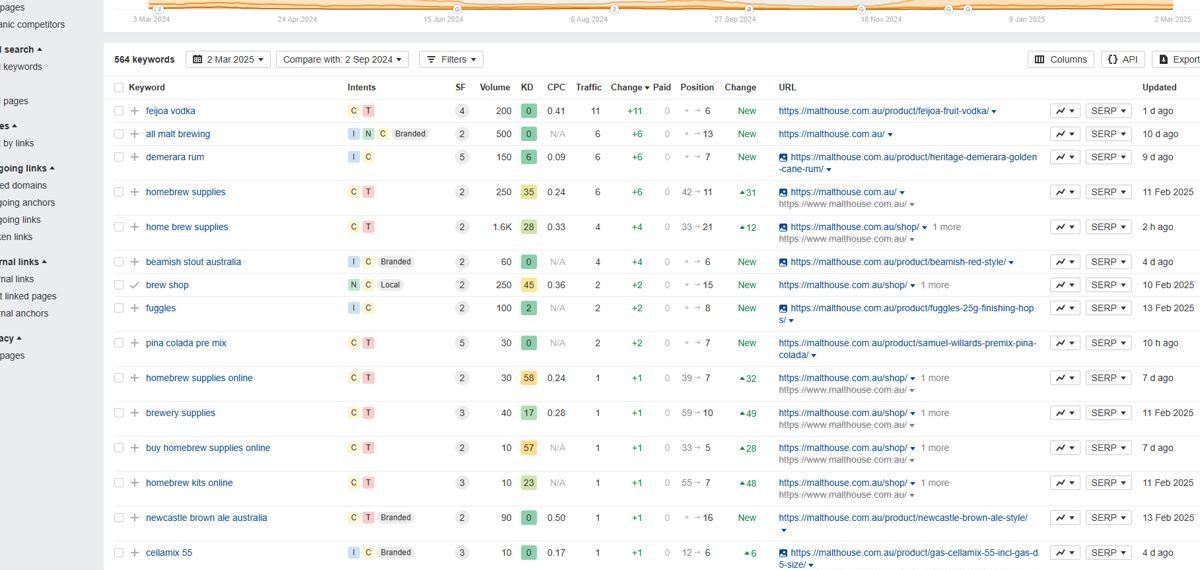
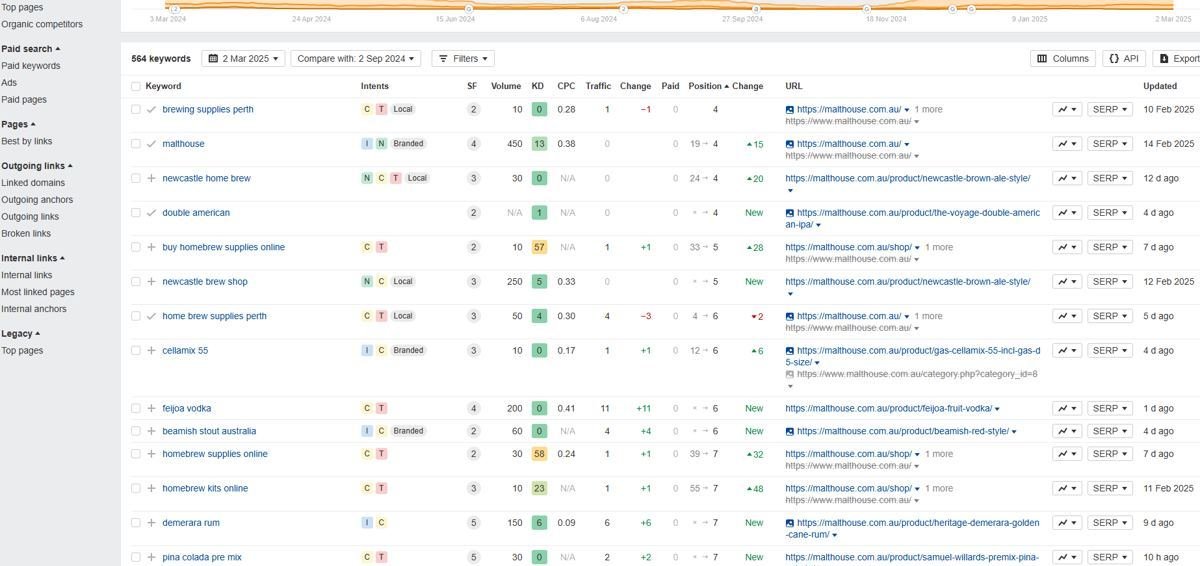
Ranking gains across 564 tracked keywords for a home-brew supply store, including “brewery supplies” from position 59 to 10
Malthouse Home Brew Supplies sells brewing equipment and ingredients to hobbyists. While working at Splotch Studio I rebuilt its search foundations with schema markup, pillar pages, topic clusters, new content and Google Maps integration. An Ahrefs comparison between September 2024 and March 2025 shows significant ranking movement for the searches that bring buyers to a brewing shop.
The Starting Point
Home brewing is a passionate, research-driven hobby. Customers compare equipment, search for starter kits, look up ingredients and read about techniques long before they buy. A shop that wants to win those customers has to appear at each stage, from early research to the moment someone is ready to purchase.
The ecommerce side adds its own challenge. Product and category pages can look thin to search engines, particularly when many pages share similar wording. In September 2024 the site already had some visibility for a few terms, but most of the valuable commercial searches placed it well beyond page one, where very few people click.
The Strategy: Structure First, Then Depth
Ranking an ecommerce store usually comes down to clarity and depth. Search engines need to understand what the store sells, how the products are organized and which pages are the authority on each subject. Customers need pages that answer questions and make buying easy. The plan combined technical structure with genuinely useful content.
- Make products and the business readable with structured data.
- Organize the catalogue into topics with strong central pages.
- Create content that serves the research stage of a home-brewing purchase.
- Support local and trust signals with map integration.
What I Did
- Optimized schema markup. Structured data clarified the business, its location and its products so search engines could interpret the pages accurately.
- Built pillar pages. Core subjects such as brewing equipment, kits and supplies became hub pages that gather authority for the broad searches.
- Organized topics. Related products, guides and categories were grouped and interlinked, giving a logical structure for visitors and crawlers.
- Created content. New pages answered the questions brewers ask, supporting the pillar pages and the product categories.
- Added Google Maps to the pages. The map connects the website to the physical business and makes it simple for local customers to find it.
Schema Markup for a Shop
For a store, structured data describes what the business is, where it operates and what it sells. When search engines can read those facts directly, they can show richer results and match the site to relevant searches with more confidence. It also reduces the risk of misinterpretation on pages that look similar to each other, a common issue on ecommerce sites.
Pillar Pages and Topics for Ecommerce
A pillar page for a subject such as home-brew kits gathers the key information in one place and links to the related products and guides. Supporting pages cover narrower topics, such as specific equipment, ingredients or techniques, and link back up to the pillar. This arrangement tells search engines which page is the main authority on each subject and spreads that authority to the product pages beneath it.
It also helps shoppers. Someone starting out can begin with an overview and move step by step to the exact items they need.
Content for the Research Stage
Brewing customers search for guidance before they buy. Content that explains what a beginner needs, how equipment works and how to choose between options captures those searches and introduces the store at the moment of interest. Each article also links to relevant products, so the research naturally leads toward a purchase.
Google Maps and Local Trust
Placing the map on the relevant pages ties the site to a real location, which is a trust signal for both customers and search engines. It also supports local searches, such as people looking for a brewing supplier near them.
The Results
Ahrefs data comparing 2 September 2024 with 2 March 2025, across 564 keywords, shows clear movement. Examples include:
- “brewery supplies”: position 59 to 10
- “homebrew kits online”: position 55 to 7
- “malthouse”: position 19 to 4
Moving from the high 50s to the top ten is the difference between page six and page one. The branded term “malthouse” also strengthened, which means customers searching for the shop by name find it more reliably.
Local Search Visibility
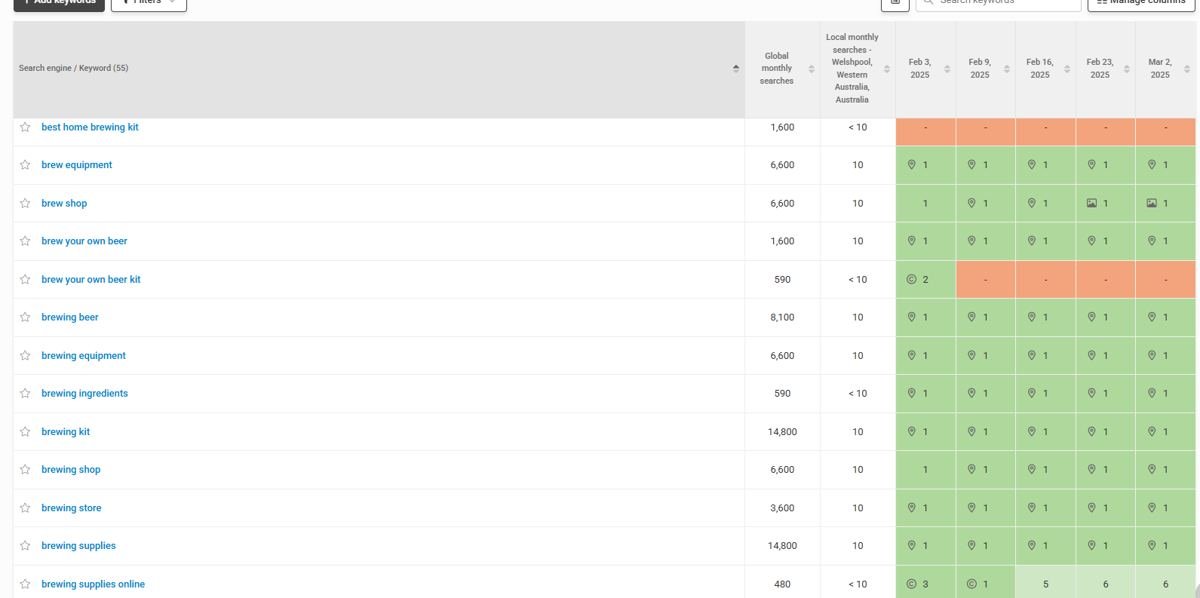
The shop also serves local customers, so I tracked how it appeared in Google’s local results. Rank tracking for 55 keywords on Google.com.au from Welshpool, Western Australia, ran weekly from 3 February to 2 March 2025. In the latest check shown (2 March 2025) the shop held position 1 for a wide set of brewing searches, including “brewing supplies”, “brewing equipment”, “brew equipment”, “brewing beer”, “brewing shop”, “brew shop”, “beer supplies” and “wine supplies”.
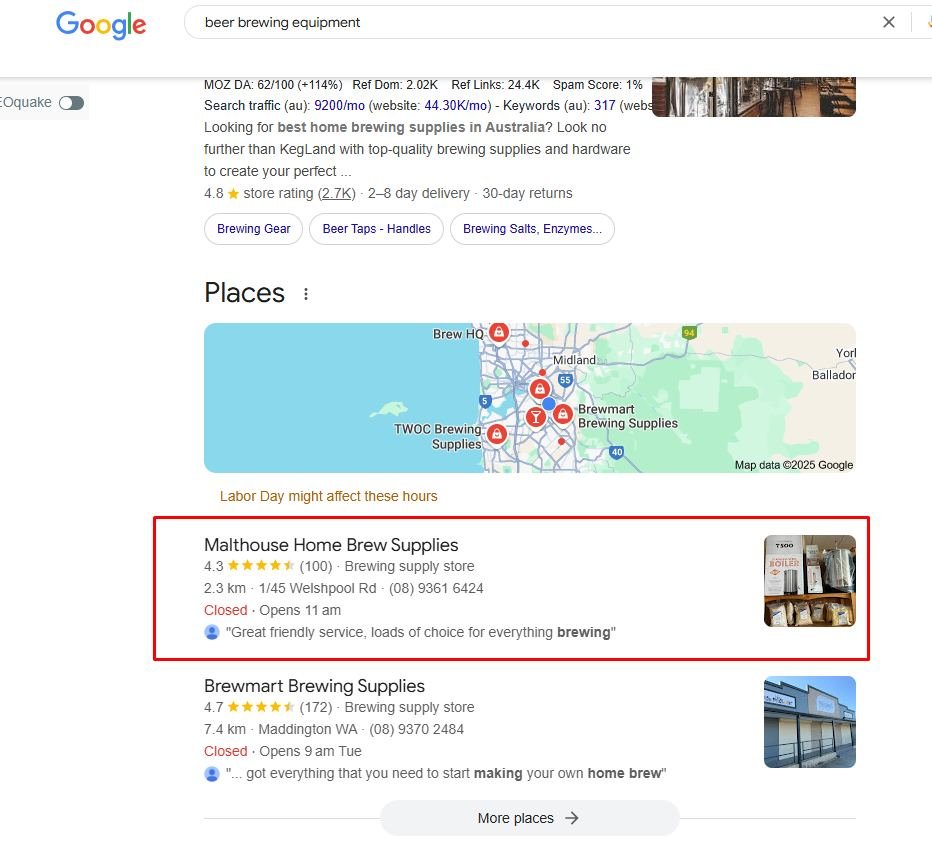
A live search for “beer brewing equipment” also shows Malthouse Home Brew Supplies in the Places results, with its address, rating and opening hours, alongside competitors.
Why Those Movements Matter
The two commercial terms are the kind a buyer uses while shopping. Page-one placement for them brings the store in front of people who are ready to buy equipment, not just browse. The stronger branded ranking protects the business from competitors and marketplaces appearing above it when a customer searches for it directly.
Limits and Honest Caveats
- This measures rankings, not sales. The comparison does not include traffic or revenue figures, and none are claimed.
- The site was not starting from nothing. It already ranked for some terms in September 2024, so these are improvements, not first appearances.
- Rankings fluctuate. Positions on two dates are a comparison, not a guarantee of where the site sits today.
- Keyword samples are examples. The three terms listed were chosen as clear illustrations from a much larger set.
Understanding the 564-Keyword Set
The comparison covers 564 keywords, a broad set that spans the main searches a home-brew shop cares about. It includes commercial searches from people ready to buy, informational searches from people learning, and branded searches from people who already know the shop. Looking at a wide set, rather than a few chosen terms, gives a more reliable picture of overall visibility. The three examples above are illustrations of the pattern across that larger set, not the entire result.
From Page Six to Page One
Search positions are not evenly valuable. Positions one to ten make up the first page, which attracts most of the clicks. Position 59 sits on roughly page six, where almost no one looks. Moving “brewery supplies” to position 10 and “homebrew kits online” to position 7 therefore changes the commercial value of those searches completely: the store went from effectively invisible to being on the page that buyers actually see. That jump is why ranking movement of this size matters even before sales data is added.
Category and Product Page Considerations
Ecommerce category pages often rank for the broad commercial searches, so they need clear headings, useful introductory text and strong internal links. Product pages need accurate descriptions and structured data so search engines understand exactly what is on sale. Thin or repeated wording across many product pages is a common weakness, and part of the work was making sure each important page had its own clear purpose and enough useful content to justify ranking.
Supporting the Customer Journey
A home brewer’s path to purchase has several stages. Early on they search for what they need to get started. Later they compare equipment and look for specific supplies. Finally they look for a supplier they can trust and perhaps reach locally. The pillar pages, the supporting content and the map presence each serve one of those stages, so the store meets the customer from first question to final purchase rather than only at the checkout.
Keeping the Gains
Rankings need maintenance. Competitors publish new content, search engines update their systems, and product ranges change. Regular reviews of the keyword set, refreshes to the most important pages and new content for emerging searches keep the improvements from fading. A steady routine is more valuable than a one-time push.
Why Structure Beats Shortcuts
It is tempting to chase individual keywords with isolated pages, but that approach rarely lasts. A store with clear schema, well-organized topics and genuinely useful content builds visibility that spreads across many searches at once, including ones nobody planned for. This is why the work focused on foundations, and why the ranking gains appeared across a large keyword set rather than a single term. Foundations also make every future page easier to rank, because each new guide or product slots into a structure that search engines already understand.
What I Would Do Next
- Tie rankings to organic sessions and sales in analytics.
- Add buying guides and comparison pages for the highest-value kits.
- Strengthen product page content and internal links from the pillar pages.
- Review the full 564-keyword set regularly to find new openings.
Takeaways
- Ecommerce rankings improve when structure, content and trust signals work together.
- Pillar pages and topic clusters concentrate authority on the searches that matter.
- Be precise about the baseline: improvement is a stronger claim than appearance.
- Report rankings as rankings, and connect them to revenue only when the data exists.
Source: Ahrefs, 2 September 2024 compared with 2 March 2025, across 564 tracked keywords. This case study reports ranking changes only and does not claim traffic or sales figures.
