Local SEO · Legal · Schema · Splotch Studio
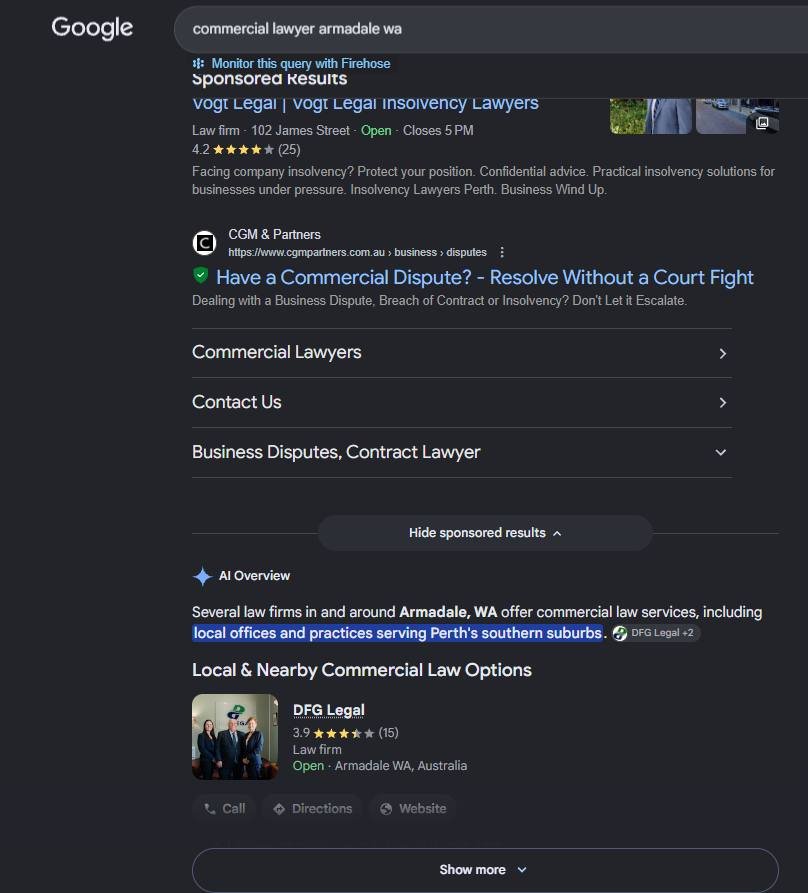
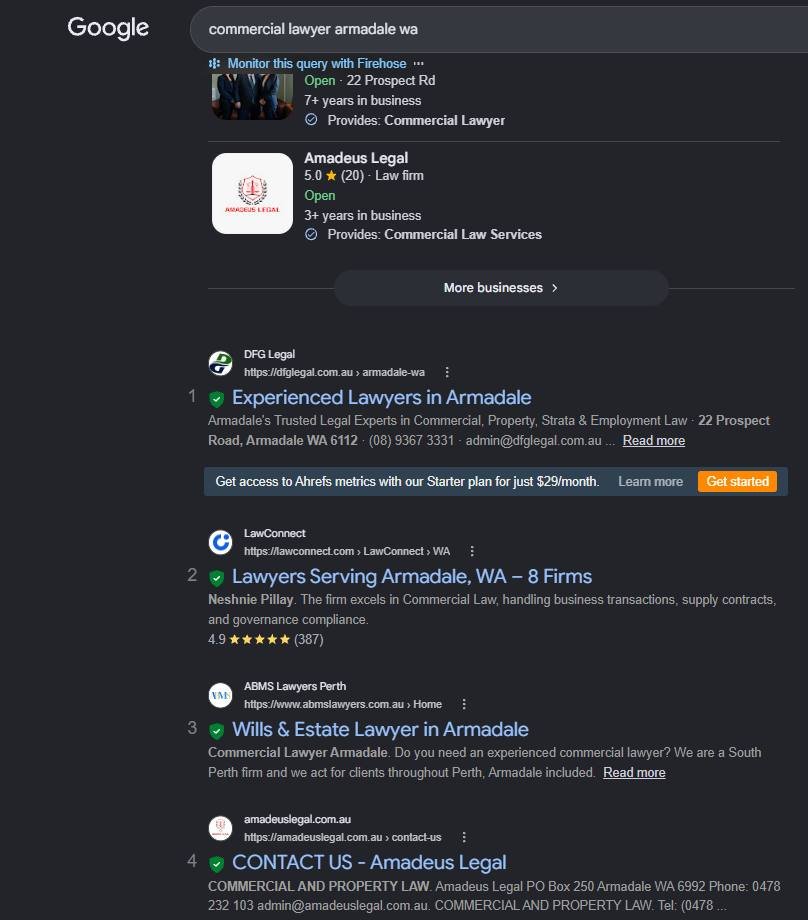
Number one organic result, the local map pack and Google AI Overviews for a commercial law search in Armadale, Western Australia
DFG Legal is a law firm in Armadale, Western Australia. While working at Splotch Studio I built its search presence around schema markup, pillar pages, topic clusters, new content and local map integration. Today, a search for a commercial lawyer in Armadale shows the firm in all three places a prospective client looks: the top organic result, the local map pack and the AI Overview.
The Starting Point
DFG Legal advises on commercial, property, strata and employment law from an office on Prospect Road in Armadale, a suburb in Perth’s south east. Like most small law firms, it relies on local clients who search at the moment they need help: a business owner facing a contract dispute, a landlord with a property problem, or an owner in a strata scheme with a disagreement.
Legal services are among the hardest categories in search. Google treats legal advice as high stakes, so it favors sites that clearly show who they are, what they cover and where they operate. The results pages are crowded with national directories, Perth city firms and paid advertising, and a suburban firm has to prove it is the most relevant answer for a very specific place and a very specific need.
The Strategy: Be the Clear Answer in Three Places
A search such as “commercial lawyer armadale wa” no longer produces a simple list of ten links. A searcher now sees paid ads, an AI-written overview, a map with nearby firms and the organic results. Each of those is fed by different signals, so the plan had to address all of them together.
- Organic results: a page that is clearly about commercial law in Armadale, written for the way people search.
- Local map pack: consistent location signals and a Google Maps presence that match the website.
- AI Overviews: well-structured, trustworthy, machine-readable pages that Google can confidently cite.
What I Did
- Optimized schema markup. I added and refined structured data so search engines can read the firm’s name, services, address and contact details without guessing.
- Built pillar pages. Each core practice area got a comprehensive page that acts as the main authority page for that topic.
- Organized topics around those pillars. Related subjects were grouped and linked so the site shows depth across commercial, property, strata and employment law, not just a list of services.
- Created new content. New pages and articles answered the questions clients actually ask, and supported the pillar pages through internal links.
- Added Google Maps to the pages. Embedding the map on location and service pages ties the website to the firm’s physical address and helps visitors find the office.
Schema Markup: Making the Firm Readable to Machines
Schema markup is structured data added to a page that describes it in a format search engines understand directly. For a law firm, it states clearly that this is a legal service, what it offers, where it is located and how to contact it. This removes ambiguity, which matters for local searches and for AI systems that summarize information. When an AI Overview chooses which sources to cite, pages with clear, consistent, machine-readable facts are easier to trust and easier to quote.
Good schema is also about accuracy. The firm’s details in the markup must match the website text and the Google Business Profile exactly, because mismatches weaken trust signals. Keeping that consistency was a core part of the work.
Pillar Pages and Topic Structure
A pillar page is a thorough, central page on a broad subject, supported by narrower pages that link back to it. For DFG Legal, commercial law, property law, strata law and employment law each became a hub. Supporting pages dealt with specific issues inside each area, and links between them showed Google how the topics connect.
This structure helps in two ways. Visitors can move naturally from a general question to the specific help they need. And search engines see a site with real depth, which supports rankings for the broad searches and for the long, specific ones such as dispute or contract questions.
Content That Answers Real Questions
Legal content has to be clear to a non-lawyer. The new pages explained common situations in plain language, described what the firm can help with and made the next step easy. Written this way, the content serves the reader and also gives search engines the context needed to match the firm to a wide range of searches.
Google Maps on the Page
Embedding the map on the relevant pages reinforces the firm’s location for both people and search engines. A visitor sees exactly where the office is, which suits a client who wants a local lawyer. Combined with a consistent name, address and phone number across the site, it supports the firm’s position in the local map pack.
The Results
A live Google search for “commercial lawyer armadale wa” shows:
- Organic position 1: the firm’s Armadale page, titled “Experienced Lawyers in Armadale”, ranks first, ahead of the LawConnect directory, ABMS Lawyers Perth and Amadeus Legal.
- Local map pack: DFG Legal appears in the “Local & Nearby Commercial Law Options” section, with its Armadale address, rating and call, directions and website buttons.
- AI Overview: DFG Legal is listed as a source behind Google’s summary of commercial law services in and around Armadale.
Appearing in all three at once matters because the searcher sees the firm repeatedly, in different formats, on one results page. That repeated visibility builds familiarity and trust before a single click.
Why the Combination Matters
Each position serves a different kind of searcher. Some read the AI summary and want a name to trust. Some go straight to the map, looking for the closest firm. Others scroll the organic results and compare. Being present in all three means the firm is considered by every type of searcher, not just those who prefer one format.
Limits and Honest Caveats
- This is a snapshot, not a before and after. It shows where the firm appears now for a specific search.
- Rankings vary by location and over time. Results differ depending on where the searcher is and can change from day to day.
- It does not measure enquiries or revenue. Visibility is the first step; the firm’s service, reputation and reviews decide who becomes a client.
- Reputation is separate. The map listing shows a 3.9 rating from 15 reviews, so collecting more positive reviews is a clear opportunity.
How the Pieces Fit Together
The work was designed as a system, not a list of separate tasks. Schema markup tells search engines what the firm is and where it operates. Pillar pages establish which pages are the main authorities. Topic structure and internal links carry that authority to the supporting pages. New content gives the site the range of answers it needs to be useful, and the embedded map confirms the physical location that the other signals describe. When these signals agree with each other, search engines can trust the site with more confidence, and that trust is what allows a suburban firm to compete with larger names.
Writing Legal Content Responsibly
Legal content carries a duty of care. Pages should be accurate, written in plain language and clear about what they offer. They should never promise outcomes, and they should make it simple for a reader to speak with a lawyer for advice on their own situation. This approach protects the firm and the reader, and it also fits how Google evaluates sites in sensitive categories, where clear authorship, accuracy and trustworthiness count for a great deal.
Measuring Success Properly
Rankings are a starting point. The measures that matter most to a law firm are enquiries, calls, form submissions and the value of the clients who come from search. A sensible tracking setup would record calls and form leads by source, watch the impressions and clicks for local searches in Google Search Console, and review which pages attract the most enquiries. That makes it possible to put a real figure on what search delivers and to invest further in the pages that perform.
What I Would Do Next
- Build a steady process for collecting client reviews.
- Track enquiries from search so rankings can be linked to real leads.
- Extend the pillar and topic approach to additional suburbs and services.
- Monitor AI Overviews to see which pages are being cited and strengthen them.
Takeaways
- Modern legal search is decided across organic results, maps and AI answers, so all three need attention.
- Schema, pillar pages and consistent location data work together, not separately.
- Plain-language content builds trust with clients and gives search engines context.
- Claim only what the data shows: this is current visibility, not a revenue figure.
Evidence is a live Google search result for a commercial law query in Armadale, Western Australia. Results vary by location and over time, and this case study does not claim leads or revenue.
